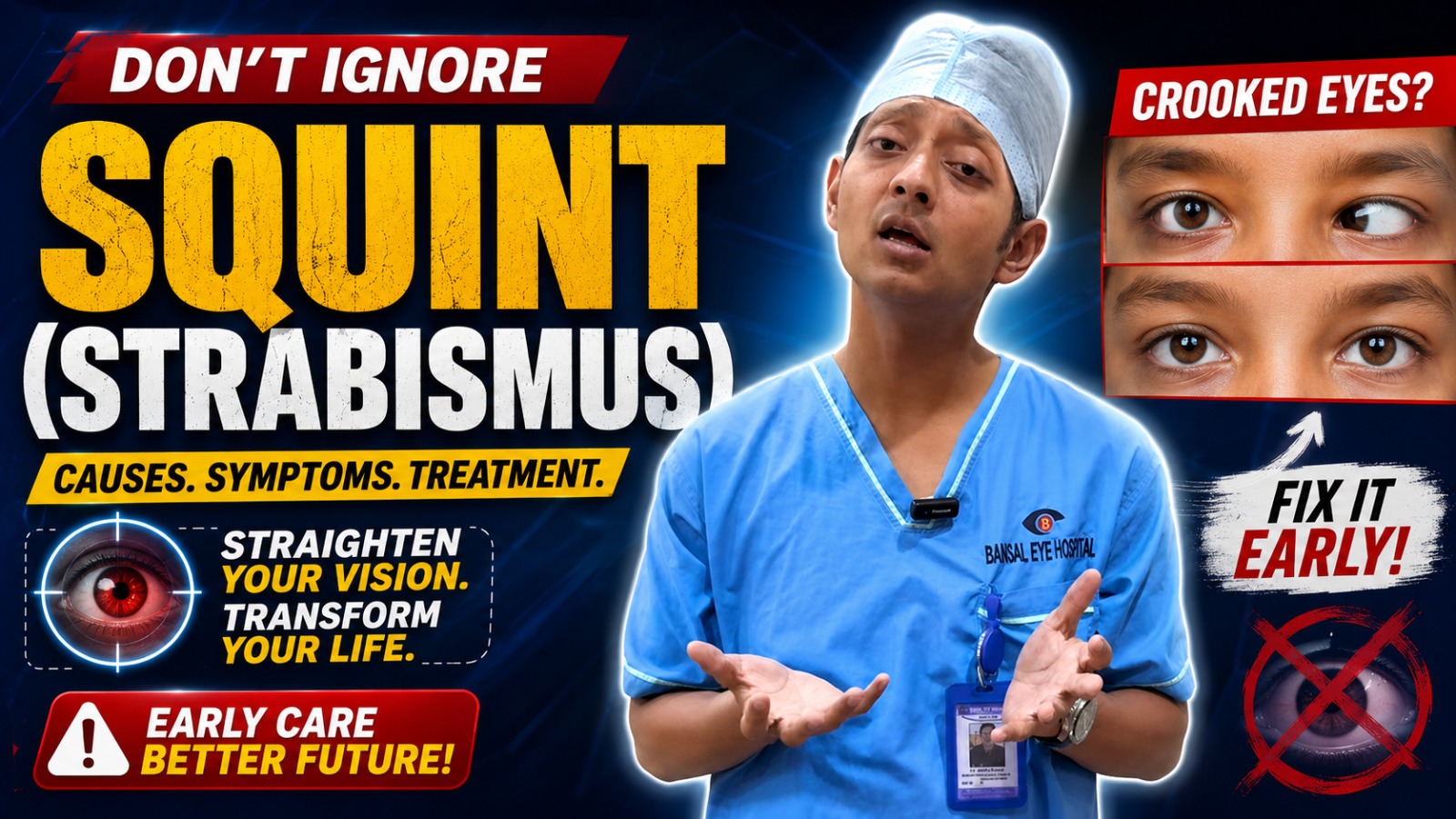
What is Squint (Strabismus)?
Squint, medically known as strabismus, is a condition where the eyes are misaligned — they point in different directions instead of working together as a coordinated pair. One eye may turn inward (esotropia), outward (exotropia), upward (hypertropia) or downward. It affects approximately 4% of children and can also occur in adults due to neurological conditions, trauma or thyroid disease.
In children, untreated squint often leads to amblyopia (lazy eye) — where the brain suppresses the image from the turned eye, causing permanent vision reduction in that eye if not treated before age 7–8 years. Early treatment is therefore critical.
Types of Squint
- Esotropia (Convergent): Eye turns inward — most common type. May be accommodative (related to hyperopia) or non-accommodative.
- Exotropia (Divergent): Eye turns outward — often intermittent, worse when tired or day-dreaming.
- Hypertropia/Hypotropia: Vertical squint — eye turns up or down.
- Paralytic Squint: Due to cranial nerve palsy — sudden onset double vision in adults.
- Infantile Esotropia: Large angle inward turning from before 6 months of age.
Treatment Options
- Glasses: Spectacle correction for accommodative esotropia — glasses alone can straighten the eye in many children.
- Patching (Occlusion Therapy): Patching the good eye forces the brain to use the amblyopic (lazy) eye, developing vision.
- Prisms: Temporarily used in paralytic squints or for small angle squints.
- Botulinum Toxin (Botox): Injection into an overacting muscle — useful in selected cases, especially recent-onset paralytic squints.
- Squint Surgery: Adjusting the eye muscles (recession or resection) under general anaesthesia to align the eyes. Outstandingly effective for most types.
The Squint Surgery Procedure
- Evaluation: Complete orthoptic assessment — measurements of angle, binocular vision testing, cycloplegic refraction and fundus examination.
- Planning: Surgical plan tailored to type, angle and muscles involved. Parents thoroughly counselled.
- Anaesthesia: General anaesthesia for children; local anaesthesia can be used in adults.
- Muscle Surgery: Conjunctiva opened, target muscles identified. Recession (moving back) or resection (shortening) performed as planned.
- Closure: Absorbable sutures used — no suture removal needed. Eye pad for 6–8 hours.
- Post-op: Antibiotic drops for 2 weeks. Review at 1 day, 1 week and 6 weeks. Glasses continued as prescribed.
When to Seek Treatment for Squint in Your Child?
- Any squint in a child below 3 years — treat urgently to prevent amblyopia
- Child closing one eye in bright sunlight (intermittent exotropia)
- Child with poor depth perception, difficulty catching objects
- One eye that appears smaller or doesn't open fully
- Head tilt or face turn to use eyes together
- Adults with new-onset double vision or eye misalignment
Frequently Asked Questions
Will my child need surgery for squint? ▾
Not always. Accommodative esotropia (related to farsightedness) can often be corrected with glasses alone. However, non-accommodative squints and large-angle squints usually require surgery. Dr. V. K. Bansal will advise after a thorough assessment.
At what age should squint surgery be done? ▾
As early as possible — ideally before age 5 years for infantile squints to allow binocular vision to develop. For accommodative squints corrected with glasses, surgery may be done if residual squint remains after glasses. Adults can benefit from surgery at any age for alignment and cosmetic improvement.
Is squint surgery safe in children? ▾
Yes, squint surgery is one of the most commonly performed paediatric eye surgeries worldwide with an excellent safety record. It is done under general anaesthesia administered by experienced paediatric anaesthetists. Risks include undercorrection, overcorrection and infection — all very manageable.
Can squint come back after surgery? ▾
About 10–15% of patients may have some degree of recurrence or residual angle, requiring a second procedure. This is more common in large angle squints or if surgery was delayed. Regular follow-up is important to detect and address any regression early.
Consult Our Expert Today
Book a consultation with Dr. VK Bansal at Bansal Eye Hospital, Ambala.