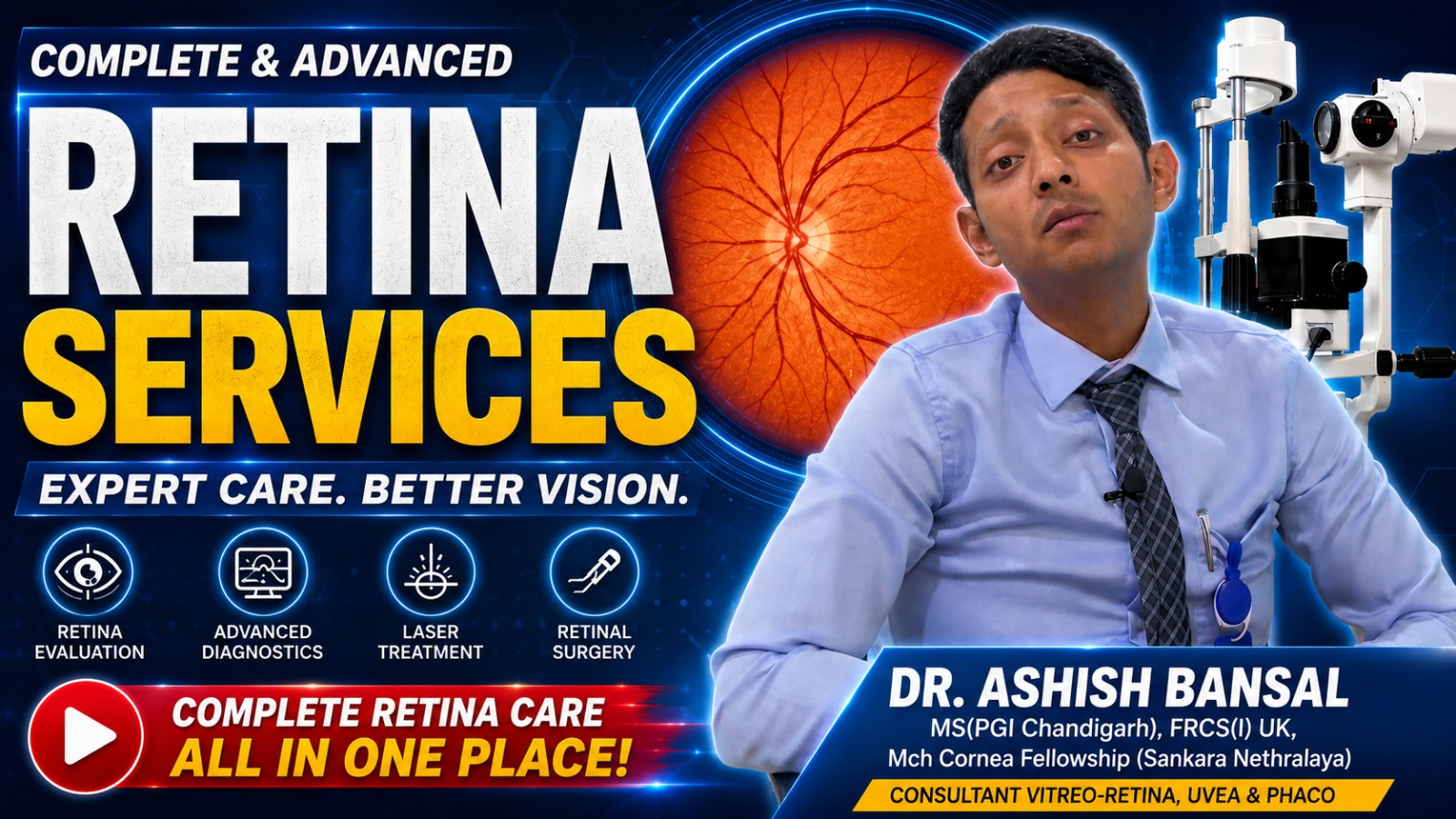
Comprehensive Retinal Care
The retina is the light-sensitive tissue lining the back of the eye — it converts light into neural signals for the brain. Retinal diseases can cause severe, irreversible vision loss if not diagnosed and treated promptly. Our retina department offers the complete spectrum of medical and surgical retinal care.
Retinal Conditions We Treat
- Diabetic Retinopathy: Retinal damage due to diabetes — most common cause of blindness in working-age adults.
- Retinal Detachment: Separation of retina from the underlying tissue — requires emergency surgery.
- Age-Related Macular Degeneration (AMD): Deterioration of the central retina (macula) affecting fine vision.
- Macular Hole: Full-thickness defect in the macula causing central vision loss.
- Epiretinal Membrane: Scar tissue on the macula causing distortion.
- Retinal Vein Occlusion: Blocked retinal vein causing haemorrhage and oedema.
- Vitreous Haemorrhage: Bleeding into the vitreous gel obscuring vision.
- Retinitis Pigmentosa and Hereditary Retinal Dystrophies
Treatments & Procedures
- Intravitreal Injections (Anti-VEGF): Ranibizumab, Bevacizumab or Aflibercept for wet AMD, diabetic macular oedema and RVO.
- Retinal Laser Photocoagulation: Seals leaking vessels in diabetic retinopathy, treats retinal tears.
- Vitrectomy: Microsurgical removal of vitreous gel for retinal detachment, macular hole, ERM, vitreous haemorrhage.
- Scleral Buckling: External surgery for retinal detachment.
- Pneumatic Retinopexy: Gas bubble injection for selected retinal detachments.
- Cryotherapy: Freezing treatment for peripheral retinal breaks.
- Fluorescein Angiography (FFA): Detailed retinal blood vessel mapping for diagnosis.
- OCT and OCT-Angiography: High-resolution cross-sectional retinal imaging.
When to Seek Emergency Retinal Care
- Sudden loss of vision in one eye
- New onset of floaters (especially shower of dots or a cobweb)
- Flashing lights (photopsia)
- Dark curtain or shadow across part of vision
- Sudden distortion of straight lines
Who Needs Regular Retinal Screening?
- All diabetic patients — annually from diagnosis
- Patients with high myopia above -6D
- Age above 60 years — risk of AMD
- Family history of retinal detachment
- Previous trauma to the eye
- Sickle cell disease and other systemic conditions
Frequently Asked Questions
Is retinal detachment an emergency? ▾
Yes, retinal detachment is a sight-threatening emergency that requires surgery within hours to days. If you experience sudden floaters, flashing lights or a curtain across your vision, go to an eye emergency immediately.
How many injections will I need for AMD or diabetic macular oedema? ▾
Treatment is individualised. Most patients need a loading phase of 3 monthly injections, then ongoing maintenance injections every 4–12 weeks based on response. Dr. V. K. Bansal will monitor your response with OCT and adjust frequency accordingly.
Is vitrectomy surgery safe? ▾
Vitrectomy is a highly refined procedure performed under local or general anaesthesia. Success rates for retinal detachment repair exceed 90% with a single procedure. Risks include infection, bleeding and cataract formation, which are discussed in detail before surgery.
Can diabetic retinopathy be cured? ▾
While the damage already done cannot be reversed, progression of diabetic retinopathy can be significantly slowed or stopped with good blood sugar and blood pressure control combined with appropriate eye treatment. Early-stage changes may even regress with optimal diabetes management.
Have Questions? Talk to Our Expert
Book a consultation with Dr. VK Bansal at Bansal Eye Hospital, Ambala.