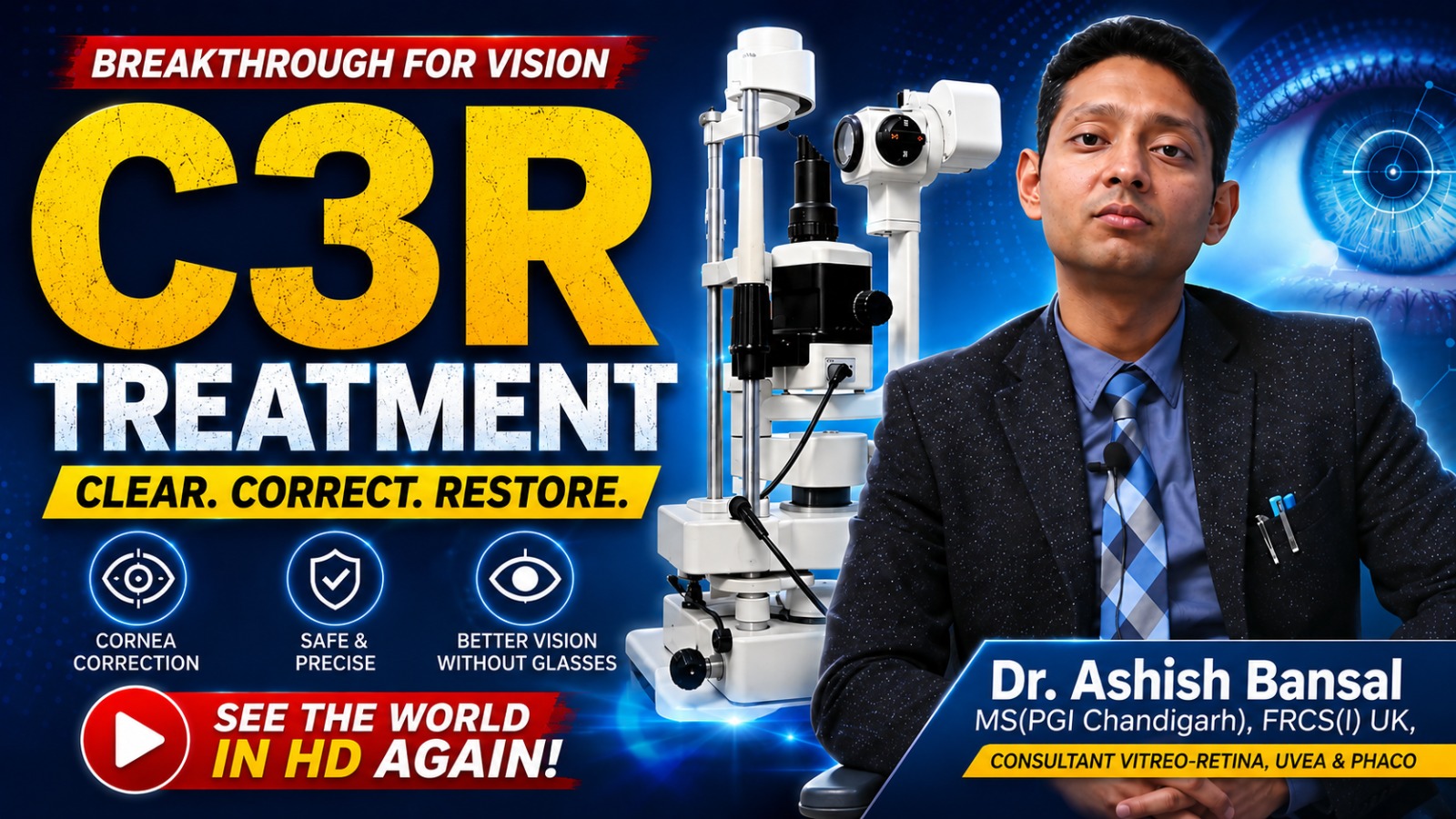
What is C3R / Corneal Cross-Linking?
Corneal Collagen Cross-Linking (C3R or CXL) is a minimally invasive procedure that strengthens the cornea by creating new bonds between collagen fibres using riboflavin (Vitamin B2) eye drops and controlled ultraviolet-A (UVA) light. It is the only proven treatment to halt the progression of keratoconus.
Keratoconus is a condition where the cornea progressively thins and bulges outward into a cone shape, causing progressive vision distortion, increasing myopia and astigmatism. Without treatment, it can lead to corneal scarring and the need for a transplant. C3R stops this progression permanently in the majority of cases.
⚡ Accelerated vs Standard C3R
We offer both standard Dresden protocol (30 min UV) and accelerated C3R (9 mW for 10 minutes). Accelerated C3R offers the same efficacy with a shorter treatment time, making it more comfortable for patients. Dr. V. K. Bansal will recommend the most appropriate protocol based on your corneal thickness and keratoconus stage.
Benefits of C3R
- Only proven treatment to halt keratoconus progression
- Prevents the need for corneal transplant in early to moderate cases
- Safe, minimally invasive, done as day-care
- Long-lasting — most patients need only one treatment
- Can be combined with topography-guided PRK for vision improvement
- Effective in all age groups including teenagers
The C3R Procedure
- Pre-operative Assessment: Corneal topography, pachymetry and slit-lamp to confirm diagnosis and staging of keratoconus.
- Epithelium Removal: The superficial corneal layer (epithelium) is gently removed from the central 8–9mm area using a sterile brush.
- Riboflavin Drops: Riboflavin (Vitamin B2) solution is applied to the cornea every 2 minutes for 30 minutes to saturate the stroma.
- UV-A Irradiation: The cornea is exposed to controlled UV-A light (365nm) for 10–30 minutes depending on the protocol used.
- Bandage Lens: A therapeutic contact lens is placed on the cornea for comfort while the epithelium heals over 3–5 days.
- Follow-up: Daily antibiotic drops for 1 week. Topography is repeated at 3, 6 and 12 months to confirm stability.
Who Should Get C3R?
- Confirmed diagnosis of progressive keratoconus (topographic progression over 6–12 months)
- Minimum corneal thickness of 400 microns (at thinnest point)
- Age 14–40 years (earlier treatment gives better long-term results)
- Patients wishing to avoid corneal transplant
- Post-LASIK ectasia (corneal weakening after laser surgery)
Frequently Asked Questions
Consult Our Expert Today
Book a consultation with Dr. VK Bansal at Bansal Eye Hospital, Ambala.