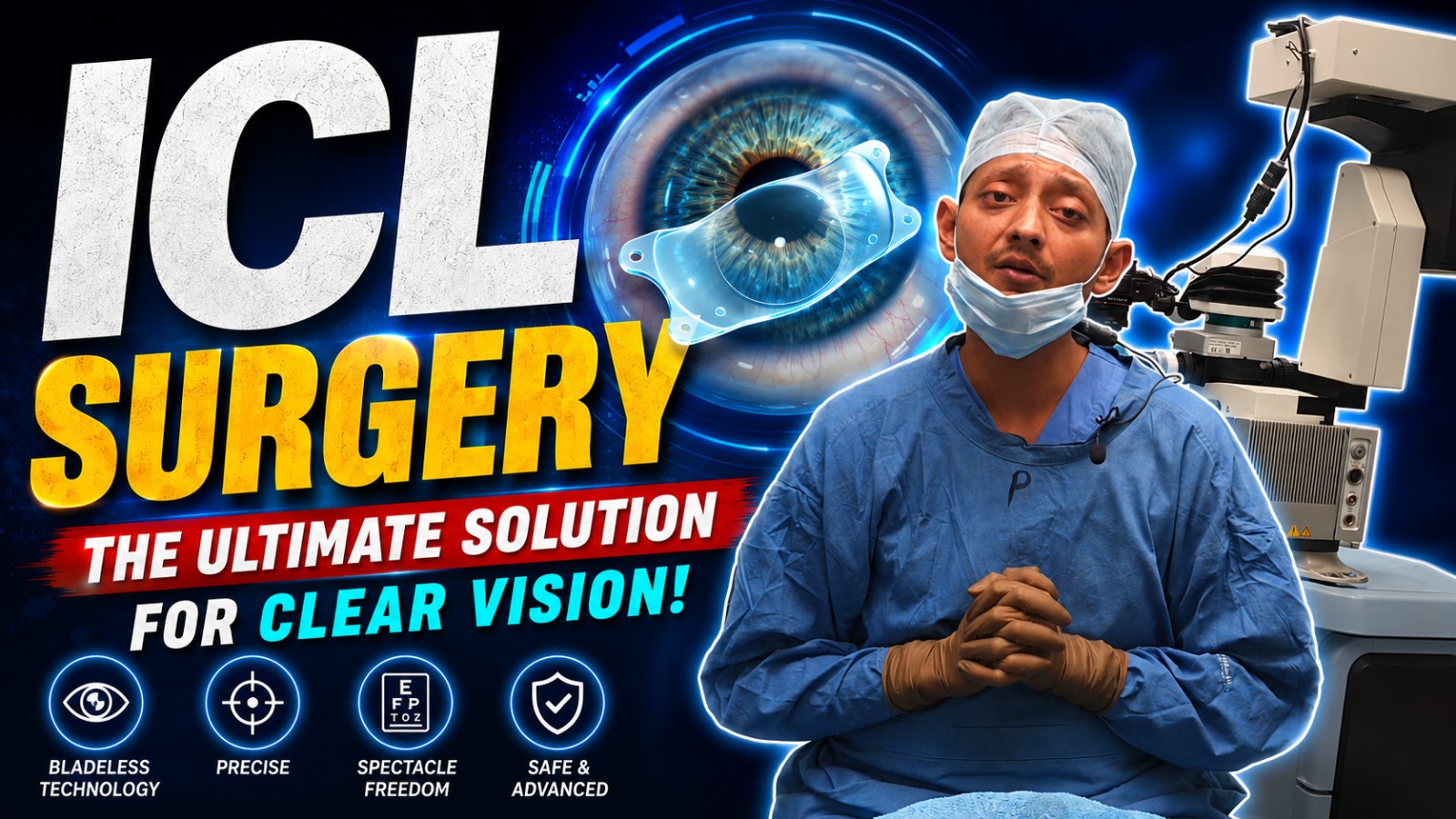
What is ICL (Implantable Collamer Lens)?
ICL, or Implantable Collamer Lens, is a premium vision correction procedure for patients with high myopia (short-sightedness) who are not suitable candidates for LASIK or SILK surgery due to high prescription, thin corneas or other factors. The ICL is a micro-thin, biocompatible lens made from Collamer — a proprietary material that is accepted naturally by the eye.
Unlike LASIK which reshapes the cornea, ICL works by adding a lens inside the eye (between the natural lens and iris) — similar to having a permanent contact lens inside. The procedure does not remove any corneal tissue, making it completely reversible if needed.
🔭 Why Choose ICL Over Contact Lenses?
Unlike external contact lenses, the ICL is implanted inside the eye and requires no daily handling, cleaning or replacement. It provides superior optical quality, UV protection, and works 24/7 without any maintenance. Most patients report vision quality that exceeds their best contact lens vision.
Benefits of ICL Surgery
- Suitable for myopia from –3D to –20D and astigmatism
- Works for patients not eligible for LASIK (thin corneas, dry eyes, high powers)
- No corneal tissue removed — procedure is completely reversible
- Superior optical quality — many patients see better than their previous best
- Built-in UV filter protects the retina
- Quick recovery — back to normal activities in 24–48 hours
- No dry eye risk (unlike LASIK)
- Excellent long-term safety record — FDA approved since 1997
The ICL Procedure
- Pre-operative Assessment: Detailed corneal topography, biometry, anterior chamber depth measurement and retinal examination to ensure suitability and determine correct lens size.
- Nd:YAG Laser PI: A tiny opening is made in the iris with a laser (YAG iridotomy) 1–2 weeks before surgery to allow fluid circulation and prevent pressure rise.
- Lens Implantation: Under topical anaesthesia, a 2.6mm incision is made. The folded ICL is injected and unfolds behind the iris in front of the natural lens.
- Centration: The lens is carefully positioned and centred. The incision seals without stitches.
- Post-operative: Antibiotic and steroid drops for 4 weeks. Intraocular pressure monitored at 1 day and 1 week post-op.
Who is Eligible for ICL?
- Age 21–45 years with stable prescription
- Myopia from –3D to –20D, astigmatism up to 6D
- Adequate anterior chamber depth (ACD ≥2.8mm)
- Healthy corneas — endothelial cell count above threshold
- Not eligible for LASIK due to thin cornea, high power or dry eyes
- Desire for excellent quality vision without external lenses
Frequently Asked Questions
Consult Our Expert Today
Book a consultation with Dr. VK Bansal at Bansal Eye Hospital, Ambala.