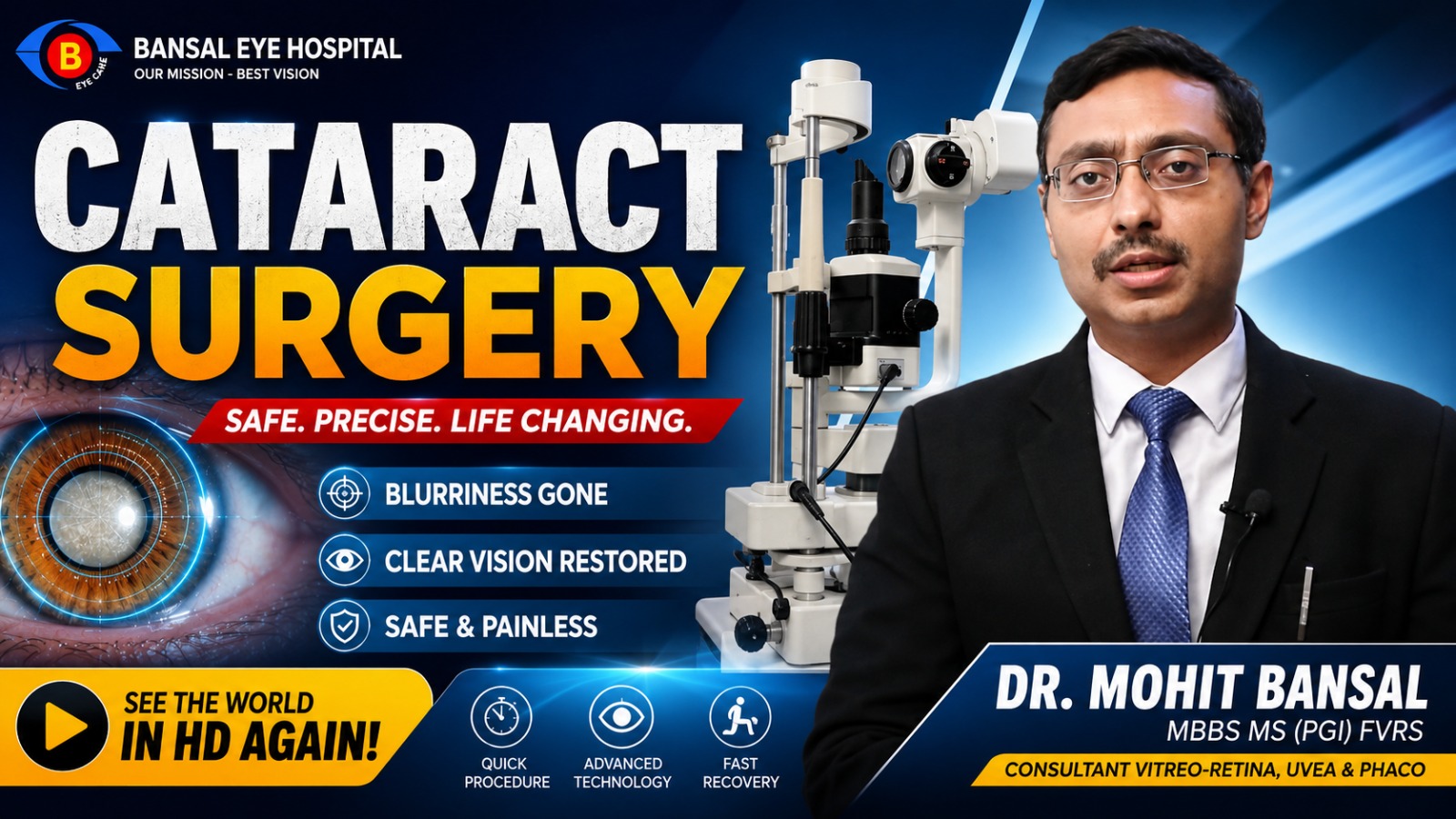
What is Cataract?
A cataract is a clouding of the natural lens inside the eye, which leads to blurred, hazy or dimmed vision. Cataracts are the leading cause of reversible blindness worldwide, but fortunately, they are completely treatable with surgery.
At Bansal Eye Hospital, we perform advanced cataract surgery using the technique of phacoemulsification (PHACO) — a micro-incision, stitchless, painless procedure that removes the cloudy lens and replaces it with a clear artificial intraocular lens (IOL). Most patients can resume daily activities within 24 hours.
Types of Lens Implants Available
- Monofocal IOL: Corrects distance vision. Reading glasses needed for near tasks. Most affordable option.
- Premium Multifocal IOL: Provides clear vision at distance, intermediate and near — reducing or eliminating the need for any glasses post-surgery.
- Toric IOL: Corrects astigmatism along with cataract. Essential for patients with significant corneal astigmatism.
- Extended Depth of Focus (EDOF) IOL: Excellent intermediate and distance vision with minimal halos — ideal for professionals who use computers extensively.
Benefits of Our Cataract Surgery
- Microincision phacoemulsification — incision less than 2.2mm, no stitches
- Painless procedure under topical anaesthesia (eye drops)
- Day-care surgery — go home the same day
- Premium lens options for glasses-free vision
- Visual recovery begins within hours
- Minimal post-operative restrictions
- Both eyes can be done 3–7 days apart
The Procedure
- Pre-operative Assessment: Optical biometry for precise IOL power calculation. Corneal topography, endothelial cell count, fundus evaluation.
- Anaesthesia: Topical anaesthetic eye drops. No injections, no general anaesthesia for routine cases.
- Phacoemulsification: A 2.2mm self-sealing incision is made. Ultrasound energy fragments and aspirates the cloudy lens.
- IOL Implantation: The chosen foldable intraocular lens is injected through the same micro-incision and unfolds inside the capsular bag.
- Closure: The self-sealing incision requires no sutures. Eye shield applied.
- Recovery: Antibiotic drops for 4 weeks. Vision typically improves noticeably by the next day.
Who Needs Cataract Surgery?
- Any age — congenital cataracts in children, age-related in adults
- Vision significantly affected by cataract impacting daily life
- Pre-existing diabetes patients (earlier surgery may be required)
- Dense cataracts with significantly reduced vision
- Secondary cataracts following trauma or long-term steroid use
Frequently Asked Questions
Is cataract surgery painful? ▾
No, modern cataract surgery is completely painless. We use topical anaesthetic eye drops — no injections near the eye. Patients are awake and comfortable throughout the 10–15 minute procedure.
What is the best lens for cataract surgery? ▾
The 'best' lens depends on your lifestyle, prescription and budget. Multifocal IOLs offer glasses independence at all distances and are ideal for patients who want to minimise spectacle use. Dr. V. K. Bansal will recommend the most suitable option after thorough evaluation.
How long is recovery after cataract surgery? ▾
Most patients see significant improvement within 24–48 hours. Full vision stabilises in 4–6 weeks as the eye heals. You can resume light activities and reading within 1–2 days, driving within 1 week.
Can both eyes be operated at the same time? ▾
We generally prefer to operate on one eye at a time, with 3–7 days between surgeries. This allows your first eye to heal and provides a 'test' of the lens power before the second eye is done.
Have Questions? Talk to Our Expert
Book a consultation with Dr. VK Bansal at Bansal Eye Hospital, Ambala.